Exercise (or stress) ECG
An ECG recorded while you walk on a treadmill.
At a glance
- How long
- About 15 minutes of exercise, within a longer appointment
- Does it hurt?
- No, and you can ask to stop at any time
- Preparation
- Comfortable clothes and trainers, no heavy meal or caffeine for 2 to 3 hours
- Supervision
- Staff watch your heart, blood pressure and symptoms throughout
What the test involves
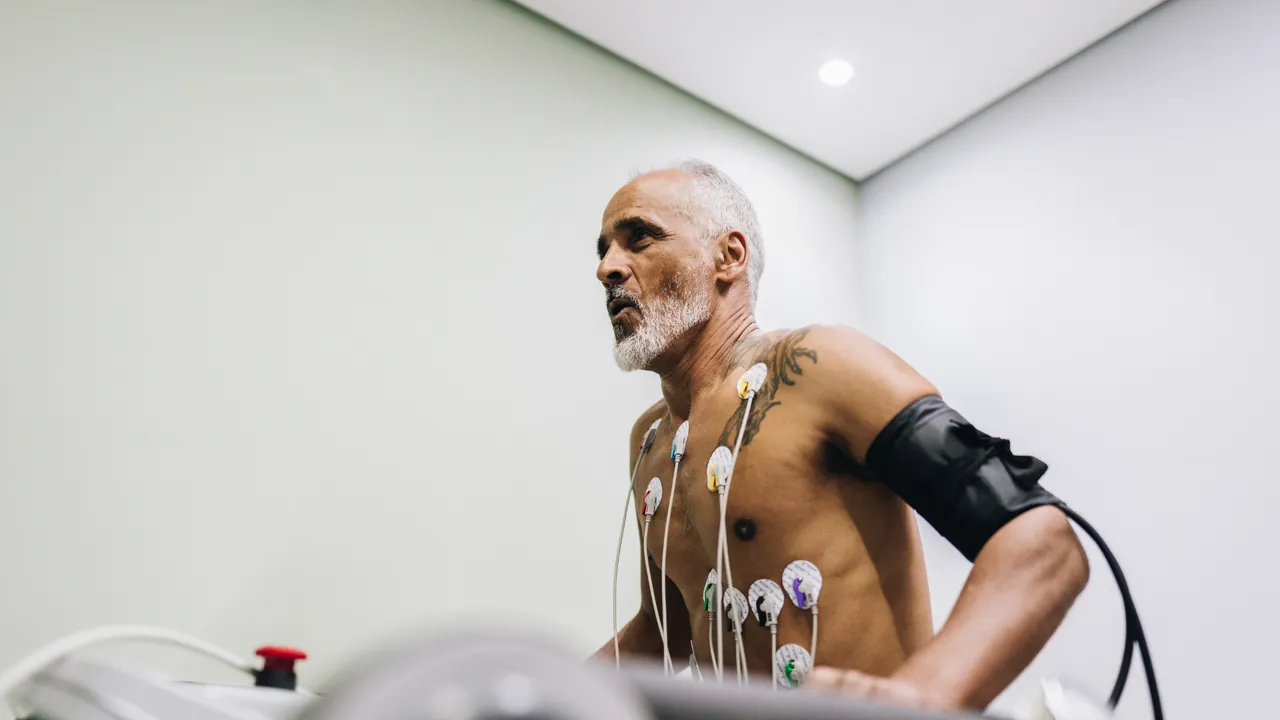
This is a common test that involves walking on a treadmill whilst attached to an ECG to monitor the patient's heart. As the treadmill gets progressively steeper and faster one can determine if there is any strain on the heart due to narrowing of the heart arteries, or any change in the heart's rhythm.
Tests are charged by the hospital that carries them out.
Why you might need an exercise ECG
Some heart problems only show when the heart is working harder. An exercise ECG, also called a stress test, records your heart while you walk on a treadmill, to see whether the heart muscle is getting enough blood from the coronary arteries. It is often used to look for coronary artery disease and to investigate:
- chest pain that comes on with exertion, which may be angina
- breathlessness with activity
- palpitations or dizziness
It can also be used after a procedure such as a coronary angioplasty, to check the blood flow to the heart.
Preparing for an exercise ECG
- Wear light, comfortable clothes and trainers or other shoes you can walk briskly in.
- Avoid a heavy meal, and drinks with caffeine, for two to three hours beforehand.
- Do not smoke for eight hours before the test.
- You may be asked to stop some medicines beforehand. Only stop a medicine if you have been told to.
What happens during an exercise ECG
Sticky pads are placed on your chest and shoulders and connected to the ECG machine, and a cuff on your arm measures your blood pressure. You start walking slowly on the treadmill. In stages it becomes steeper and faster, so that your heart gradually works harder.
Staff watch your ECG, heart rate and blood pressure the whole time and ask how you feel. Tell them straight away if you have chest pain or discomfort, feel dizzy, very tired or very short of breath. The test stops once enough information has been gathered, if symptoms develop, or whenever you feel unable to carry on. You will not be asked to do anything that feels too difficult for you.
Afterwards you rest until your heart rate and breathing have settled, and then you can go home.
Is an exercise ECG safe?
Yes, for the people it is chosen for. Your history and symptoms are checked first to make sure the test suits you, it is supervised throughout, and it is stopped promptly if there are worrying symptoms or ECG changes. Serious complications are rare.
A normal result does not rule out every kind of heart disease, as some narrowing of the arteries does not show clearly on an exercise ECG. If you cannot walk on a treadmill, or more detail is needed, other tests such as a CT coronary angiogram or a stress echocardiogram may be suggested instead.
The hospital that carries out your test will send you its own instructions. If they differ from this page, follow theirs, and ask if anything is unclear.
Where this information comes from
Sources checked 14 October 2026.
Symptoms this test can help investigate
- Chest painChest pain that is aching in nature, and which is brought on by exertion (walking or other exercise), is usually referred to as angina, and can be due to a narrowing of the arteries feeding the heart muscle.Read about chest pain
- FatiguePersistent tiredness that is not explained by activity levels, sleep, or recent illness can sometimes be linked to heart conditions.Read about fatigue